

Round pen kits for Texas
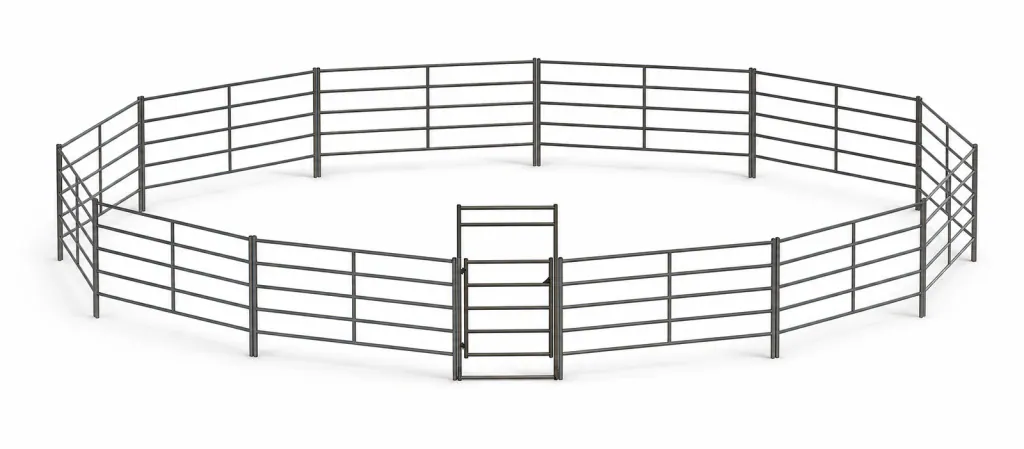
40 ft steel round pens
Groundwork on foot and colt starting on a small place. A 40 ft circle needs the least level ground, which helps on a Hill Country lot where limestone sits just under the grass, or on a few acres at the edge of Dallas–Fort Worth, Austin or San Antonio.
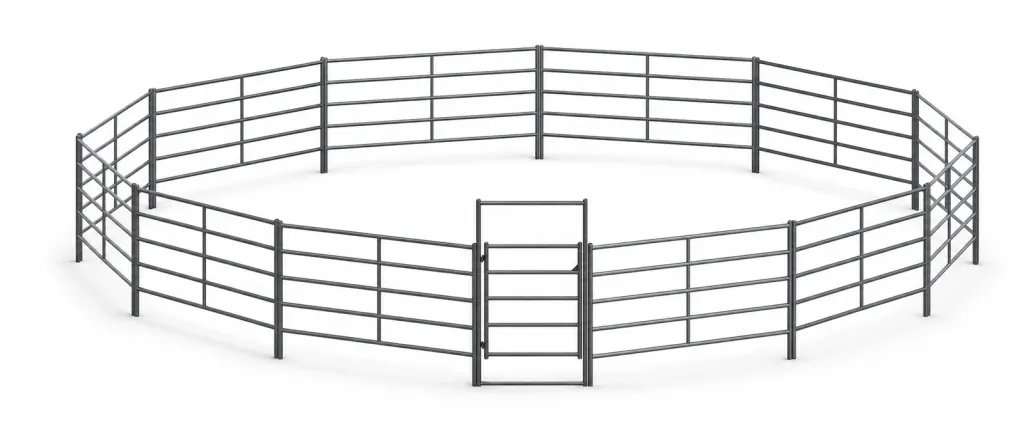
50 ft steel round pens
The usual pick for groundwork plus some riding, and the safe one if you haven't decided. On Blackland Prairie or Gulf Coast clay, a 50 ft circle keeps the raised, crowned pad to a size one tractor can build and keep dragged.
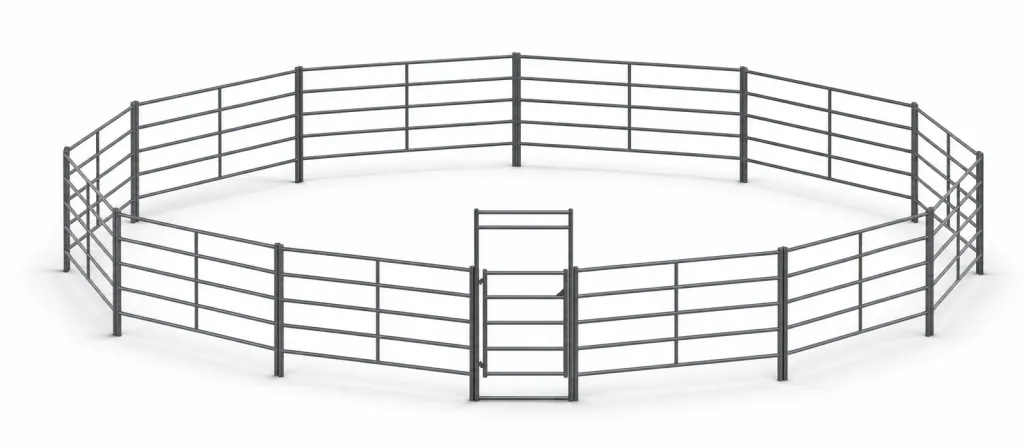
60 ft steel round pens
For riding in the pen regularly. The flat, open ground of the Panhandle, the Rolling Plains and South Texas has room for a 60 ft circle and the working space outside it. Keep a hydrant close, because West Texas wind dries a big footing fast.
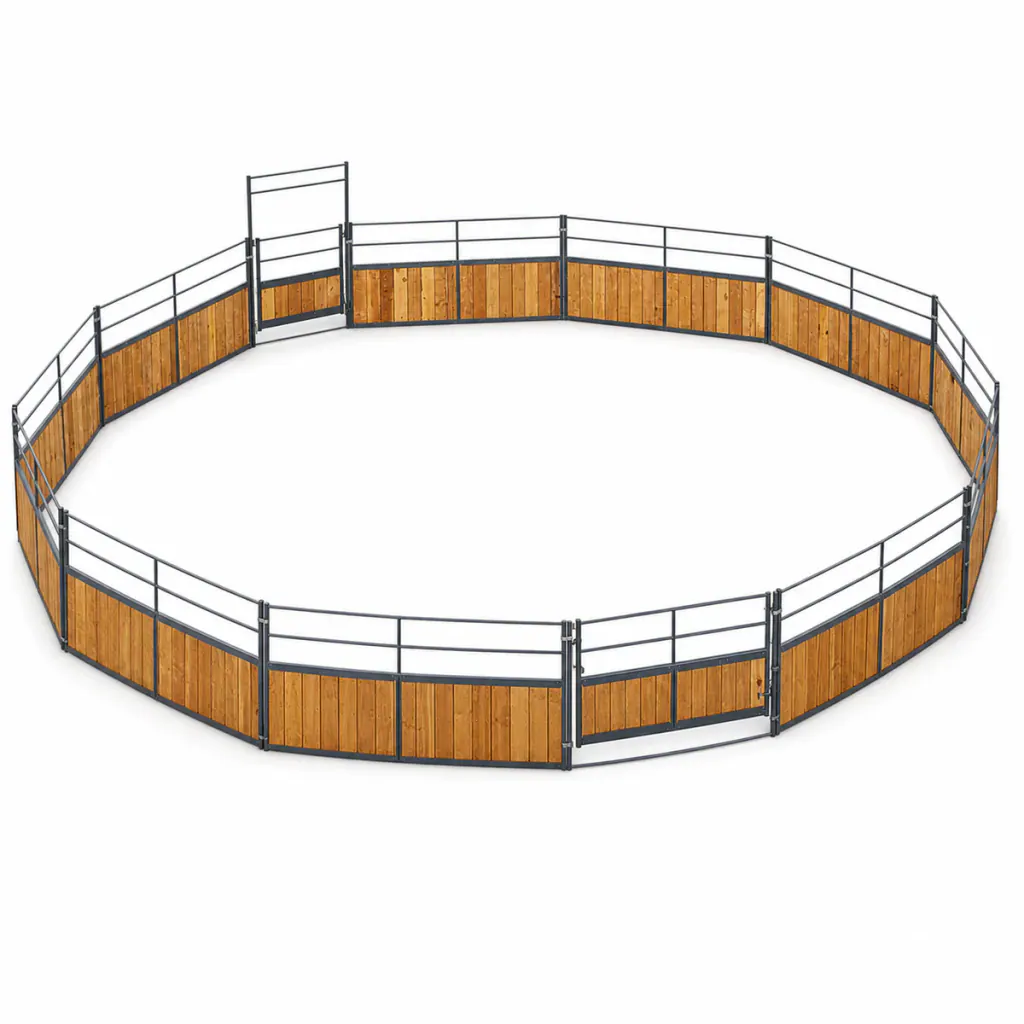
Wood-insert round pen
C-channel along the lower part of each panel holds 2x6, 2x8 or 2x10 boards you supply, with a separate 10 ft swing gate for equipment. It suits a pen near the house or beside a wood-fenced front pasture, where looks count as much as the work. Wood is not included.
Round pen ground from the Blackland Prairie to the Hill Country
Texas ground changes a lot from one region to the next. The Blackland Prairie, the band of dark clay that runs from the Red River down through Dallas, Waco and Austin toward San Antonio, is shrink-swell soil. Houston Black, the state soil, cracks wide open in a dry August and swells and turns sticky after a rain. West of Austin and San Antonio, the Hill Country and Edwards Plateau have thin, rocky soil over limestone, often with caliche a few inches down. Along the Gulf Coast, the flat prairie clay that people call gumbo can hold standing water for days.
East Texas, from the Piney Woods down through the Post Oak Savannah, is mostly sandy loam over a clay subsoil, so it drains well on top until the water reaches the clay. The High Plains around Amarillo and Lubbock are flat loam and clay loam, sandier on the South Plains, and the Trans-Pecos and the South Texas brush country run to sand and caliche. A local dirt contractor can tell you what your soil means for a pad, and a shovel test after a rain shows how fast the top drains.
The panels stand on the ground and clamp together, so whatever the pad does, the circle does too. On Blackland clay, build the pad up above the ground around it with a compacted base, crown it so rain runs out under the bottom rail, and expect some movement through a wet and dry cycle. On Hill Country rock, scrape the circle and clear loose stone, because rock works up through footing. On deep sand, compact a firm base first so the footing doesn't turn into a soft bowl.
Texas heat, flash floods and northers around a round pen
Rain across Texas runs from less than 10 inches a year around El Paso to more than 50 along the Sabine River. In the Hill Country a slow-moving storm can put a creek or a dry draw out of its banks in an hour, so keep the pen out of low ground, draws and creek bottoms, even when they are the flattest spots on the place. On the Gulf Coast and in East Texas, tropical rain and humidity keep clay wet for long stretches. Walk your site after the heaviest rain you can and set the pen where water leaves fastest.
Heat decides when a pen gets used. From June through September many people work horses early or late in the day, so put the pen where the barn or a tree line shades the gate side at those hours, and keep a hydrant close for the footing and the horse. On the High Plains and in West Texas, wind dries footing fast, and winter brings blue northers, hail and the odd ice storm. On Blackland clay, a long drought followed by a wet spell can heave the pad unevenly. After either, walk the circle, set any panel that has shifted back in line and check the clamps.
Which round pen kit suits which part of Texas
On a small place outside Dallas–Fort Worth, Austin, San Antonio or Houston, the 40 ft pen is often the only circle that fits with room left for a trailer and turnout. It takes 12 panels and covers about 1,260 sq ft. The 50 ft pen, 15 panels and about 1,960 sq ft, is the usual choice for groundwork plus some riding, and it keeps the built-up pad on Blackland or Gulf Coast clay to a size one tractor can handle.
The 60 ft pen takes 18 panels and about 2,830 sq ft. It suits the open ground of the Panhandle, the Rolling Plains and South Texas, where space is easy and the extra 870 sq ft of footing over a 50 ft pen is mostly a question of water and dirt work. The Signature Series, the same circles framed to hold your own boards with a 10 ft swing gate added, suits a pen near the house or along a front fence.
Leave about 10 ft clear around any size for the gate, mowing and a tractor, which makes the level area about 60 ft across for a 40 ft pen, 70 for a 50 and 80 for a 60. On the short, flat benches of the Hill Country, measure that full width before you pick a size.
Four or five rails, and how bare steel weathers across Texas
Every steel kit is built from 10 ft by 5 ft panels of 14-gauge steel, with 1-5/8 in posts, 1-1/4 in rails and welded end caps. Four rails leave 14-1/4 in gaps. Five rails close them to 10-1/4 in, which is the better pick for colts and green horses, ponies and minis, or any pen people can walk up to, such as a lesson barn or a pen beside a farm-to-market road. Four rails weigh less, cost less and suit a settled horse.
Bare metal is the standard finish and the least expensive. It weathers to a surface-rust patina, and how fast depends on where you are. Near the coast, salt air and Gulf humidity bring it on quickly; in the dry Trans-Pecos it comes much more slowly. If you want the pen to hold a color, dapple grey, black or a custom powder coat costs more and is chosen on the product page. The steel under the finish is the same panel either way.
Round pen freight to Texas ranches and acreages
We deliver round pens to every part of Texas, from Dalhart to Brownsville and from El Paso to Orange. Freight is priced from the road miles to your address, as one load, with a $200 minimum. You see the amount before you pay. Texas has two exceptions. Large orders ship free anywhere in the state, and smaller orders delivered near I-10, I-40 or US-287 ship at a flat rate. A round pen on its own is normally a smaller order, so the flat rate applies if you're near one of those highways. The delivery page gives the order size and the exact areas.
The driver brings the load to your place but doesn't unload it, so have a tractor with forks, a skid steer or enough people ready. Ranch entrances bring their own problems: a narrow cattle guard, a low-water crossing on a caliche road, or a Blackland drive that turns to grease after rain can all stop a loaded truck. If any of those apply, meet the truck at the county road or a gravel pad and carry the panels in from there. Tell us about gates, low wires or tight turns when you order.
No post holes: standing up a round pen on Texas rock and clay
A steel kit needs no posts and no concrete. You stand the panels in a circle, hang the 4.5 ft bow gate and fit the clamps: 26 for a 40 ft pen, 32 for a 50 and 38 for a 60. That matters most in the Hill Country and West Texas, where an auger often stops on limestone or caliche a few inches down. Have the pad level, firm and finished before delivery, set the panels, then haul in footing so it stays inside the circle. If you'd rather not put it up yourself, ask about installation when you request a quote.
The Signature Series is the one exception. Its 10 ft swing gate hangs on an 8 ft by 2-3/8 in post, and setting that post is your job; on rock, plan for a rock auger or a contractor who has one. Before you build, check with your county, and inside city limits or a subdivision, with the city and any HOA or deed restrictions. Because nothing is buried, you can unclamp a steel pen and move it if the spot holds water, or take it with you if you sell the place.