

Portable stall project kits for Texas
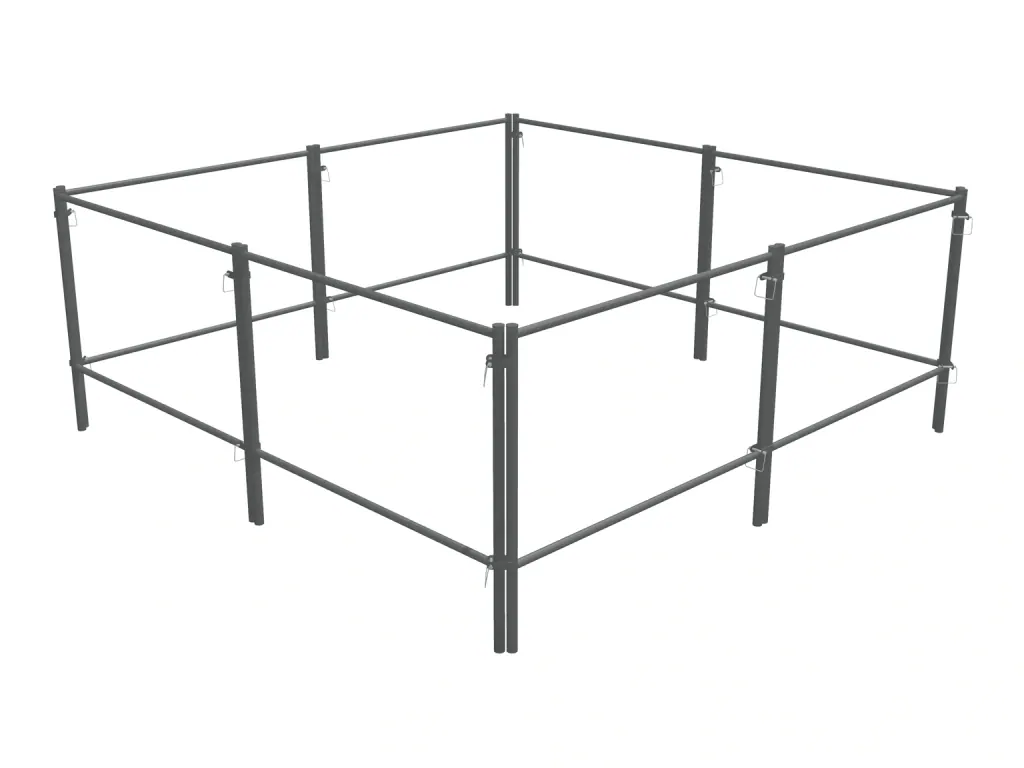
10×10 portable travel pen
Built for the long Texas haul: eight 5 ft panels lie flat in the trailer and clip into a 10 × 10 ft pen at a trail camp, a ranch rodeo or an overnight stop. Set it where the trailer's shadow falls in the afternoon, because the pen itself has no roof.
Trail camps, ropings and overnight stops across Texas
Texas is big enough that a trip with a horse often means a night away from home. Trail riders haul to camps on the grasslands north of Decatur, in the hills outside Bandera, along the canyons below the Caprock in the Panhandle and in the pine woods of East Texas. Ropers and barrel racers drive from one weekend event to the next. A 10 × 10 ft pen gives a horse room to stand, eat, drink and lie down at the trailer, instead of spending the night tied to it.
Shows work differently. Big show venues usually have stall barns, and rules on pens vary from one grounds to the next. The travel pen earns its place in the camping area at a ranch rodeo or a playday, at a friend's place where you lay over on a two-day haul, and at the barn you head for when Gulf Coast horses go inland ahead of a hurricane. Before you load it for any event, check the event's rules on portable pens.
Setting a travel pen on caliche, sand or blackland clay
Texas ground changes from one end of a trip to the other. Across the Hill Country and much of West Texas, caliche and limestone sit just under the surface, and the ground is hard and stony. The Blackland Prairie, from San Antonio up past Dallas, is heavy clay that cracks open in August and turns to sticky gumbo after rain. Parts of the Panhandle and West Texas are sandy, and East Texas camps sit on sandy loam under pine needles.
Before a panel comes off the trailer, walk the 10 × 10 ft square. Pick up wire, glass and loose rock, and look for fire ant mounds, which are common across much of the state; a horse penned on a mound will be stung. Choose the flattest spot you can. On a slope or a rutted pull-through, a panel end can hang in the air, and a gap under the bottom rail is where a horse paws and catches a foot. Set the pen so every panel sits on the ground.
Check the footing again in the morning. Clay that was firm when you arrived can be slick after a night storm, and panels on sand can settle unevenly as the horse moves around. If a corner has dropped or a clip has worked loose, reset it before you leave the horse for the day.
Afternoon shade and water at a Texas summer camp
The pen has no roof, so shade comes from where you put it. A tree line is best. The trailer is the next best thing, but its shadow moves: through the afternoon it falls on the east side, which is where the pen wants to be on a July day. Look at where the shade will be at four o'clock, not where it is when you pull in at noon.
Water matters as much as shade. A horse drinks far more in Texas heat than it does at home in the spring, and some horses drink less when the water tastes different. Haul water from home if you aren't sure what the camp has, hang buckets from a rail inside the pen with a strap, and check them at dusk and at first light. In dry West Texas air, sweat dries almost as fast as it forms, so a horse can lose a lot of water without looking wet.
Spring brings hail and thunderstorms across North and Central Texas, and Panhandle nights can turn cold in April or October. A pen of short steel panels is not shelter from any of that, so when storms are forecast, decide ahead of time where the horse will go. Don't tie a tarp or shade cloth to the panels in wind; the fabric catches gusts and can pull the pen out of line.
Packing eight pen panels for a long Texas drive
The kit is eight 5 ft panels and a set of connecting clips. Two panels make each 10 ft side. They are 14-gauge steel with 1-5/8 in posts, 1-1/4 in rails and welded end caps, and they come apart flat. Ask for the panel height when you order, then measure the floor of the tack room, the trailer's nose or the truck bed before you count on a spot. Strap the stack down so it can't slide toward the horses or rattle for 400 miles, and keep the clips together in a bucket or bag.
One person can set the pen up. Stand two panels at a corner and clip them, then work around the square, keeping the corners close to square so the last clip lines up. Check that every clip is seated and its locking pin is in. Ask how the entry works on this pen when you order, and plan which side faces the trailer so the walk in is short. Don't tie a horse to the panels; a freestanding pen will move with a horse that pulls back.
Free and flat-rate freight along Texas highways
How a travel pen ships in Texas depends on where it is going and what rides with it. Big orders go free to any Texas address. A smaller order delivered near I-10, I-40 or US-287 goes for a flat rate, and the delivery page gives the order size and the exact areas that qualify. Off those three highways, in much of deep East Texas or the Big Bend country, a smaller order is priced on distance. Freight is priced from the road miles to your address, as one load, with a $200 minimum. You see the amount before you pay.
A travel pen on its own is a small order. If you're also buying a stall kit, a round pen or panels, order the pen with them and it comes on the same load. The driver brings the load to your property but doesn't unload it, so plan to lift the panels off by hand or take them off with the rest of the order on forks. Tell us about a narrow gate, a low wire or a long caliche drive when you order.
Quarantine pens on a Texas place, and when a stall kit fits better
At home the pen does short jobs. It keeps a horse bought at a sale apart from the herd, set well back from other horses' fence lines with its own buckets, for as long as your vet advises. It holds a horse while you fix fence after a storm, gives a visiting horse a place to stand, and takes in a horse evacuated from the coast when friends need room. When the job is done, the panels go back in the barn flat.
Some jobs need a regular stall instead. At 100 sq ft, the travel pen is smaller than a 12×12 stall at 144 sq ft. If a vet has prescribed stall rest, follow their instructions on space. Most people want more room than 10 × 10 ft for a mare to foal, and a horse that will live in a pen through a Texas summer needs shade the travel pen can't give. For those jobs, look at the 12×12, 12×24, 20×20 and 24×24 stall kits, which have a gate and full-size panels, and come in covered versions.