

Round pen kits for New Mexico
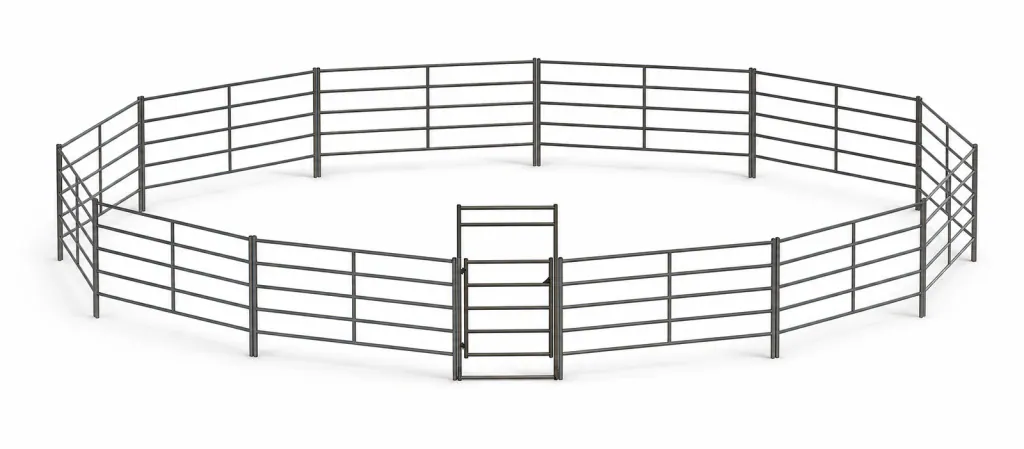
40 ft steel round pens
Groundwork on foot on a narrow irrigated lot in the Rio Grande Valley, from Corrales down to the Mesilla Valley. A 40 ft circle gives up the least pasture, and it has the least footing to keep damp when your water comes from a domestic well.
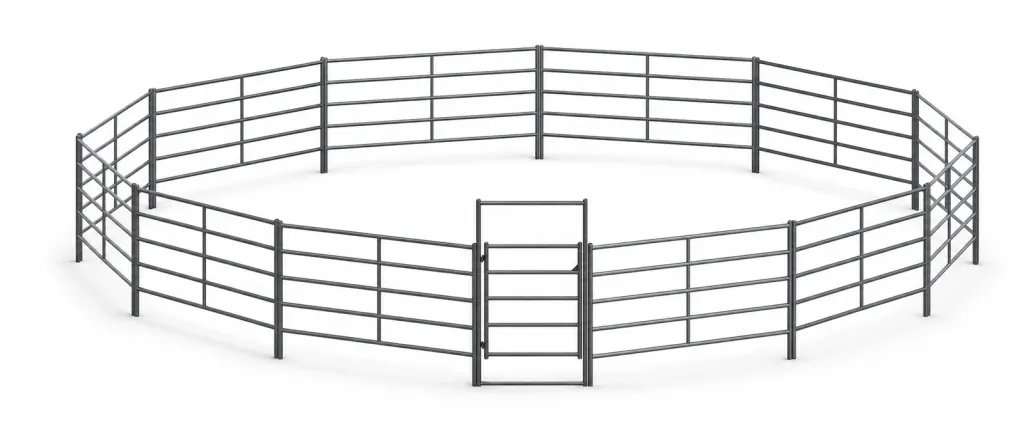
50 ft steel round pens
The usual choice for groundwork plus some riding, and the safe one if you're unsure. On a Pecos Valley place around Roswell or Artesia, a 50 ft circle keeps the leveling and the base over caliche or sandy loam to a manageable job.
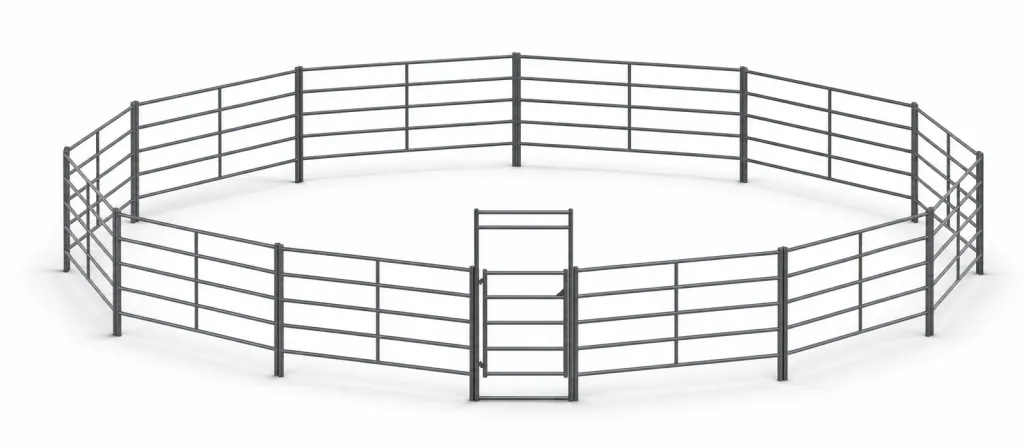
60 ft steel round pens
For regular riding in the pen. The open eastern plains around Clovis and Portales and the flat Estancia Valley have room for a 60 ft circle and the working space around it. Spring wind dries a large footing quickly, so plan on water.
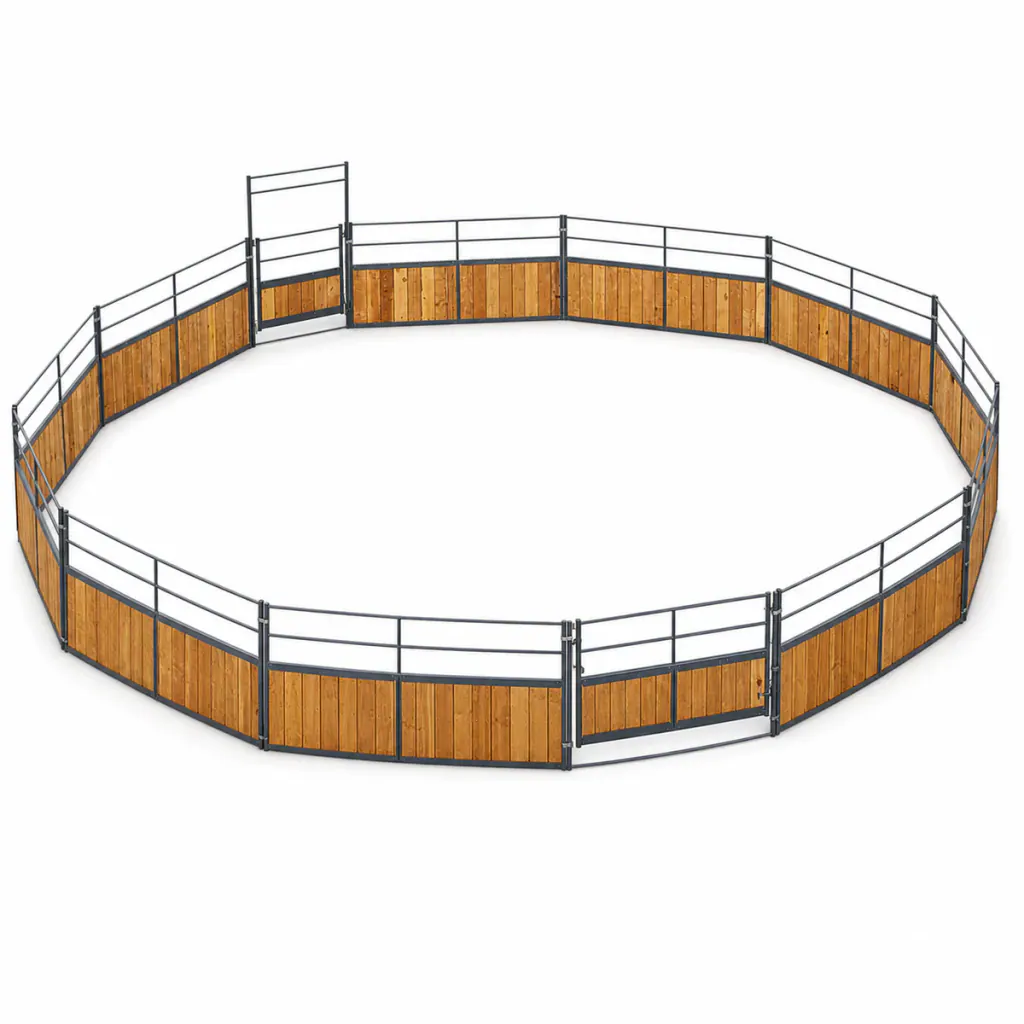
Wood-insert round pen
A board-sided pen suits a place near Santa Fe, Placitas or Corrales where the pen sits close to the house. C-channel holds 2x6, 2x8 or 2x10 boards you buy locally, which also keep some blowing sand and tumbleweeds out, and a 10 ft swing gate takes equipment. Wood is not included.
Round pen ground on caliche, sand and Rio Grande loam
Much of southern and eastern New Mexico has caliche under it: a hard, cement-like layer of calcium carbonate that can sit anywhere from a few inches to a few feet down. On the eastern plains around Clovis, Portales and Hobbs it often lies under sandy soil, and the sand on top blows and shifts. The Rio Grande Valley, from Española down through Albuquerque, Socorro and the Mesilla Valley, is river-laid loam and sand, with pockets of heavy clay and groundwater that can sit close to the surface near the river.
Elsewhere the ground changes again. Parts of the Pecos Valley and the Tularosa Basin have gypsum-rich soil, which can soften and settle when it gets wet. The northern mountains around Santa Fe, Taos and Las Vegas run to rocky, clay-heavy ground on slopes, and around Farmington shale and sandstone come close to the surface. A local dirt contractor, or a neighbor who has built a pad nearby, can tell you what's under your pasture and what it means for a pad.
Exposed caliche can make a firm base once it's leveled and compacted; crushed caliche is a common road base in the south and east of the state. Put a sand or sand-mix footing on top, because bare caliche is hard on legs. On deep sand, compact a base first so the footing doesn't go soft. In the valley, build the pad a little above the ground around it so irrigation water and storm runoff go around the circle instead of into it.
Monsoon storms, spring wind and altitude at a round pen
Most of New Mexico gets less than 15 inches of rain a year, and Albuquerque and Las Cruces often get less than 10. A large share of it falls in the July to September monsoon, in short, heavy storms that dry ground can't soak up. The water runs off fast and fills arroyos that sit dry the rest of the year. Keep a round pen out of arroyo bottoms and off the low side of a slope, however flat and sandy they look, and walk the site after a monsoon storm before you commit.
Spring is the windy season. From March into May, strong, dry wind blows footing out of the pen, drifts sand along the bottom rail and piles tumbleweeds against the panels on the eastern plains. A pen on the lee side of a barn or a tree line loses less, and damp footing blows less, so plan for a hose or a hydrant. Altitude adds winter. Elevation runs from about 4,000 ft in the Mesilla Valley to 7,000 ft around Santa Fe and Taos, and northern pens see snow and freeze-thaw that can heave clay. Walk the circle each spring, line the panels back up and check the clamps.
Matching round pen size to valley lots, plains ranches and well water
On a narrow irrigated lot in Albuquerque's North or South Valley, Corrales or the Mesilla Valley, the 40 ft pen is often the one that fits without giving up pasture. It takes 12 panels and about 1,260 sq ft, and it's the size for groundwork on foot and starting young horses. The 50 ft pen, with 15 panels and about 1,960 sq ft, is the usual choice for groundwork plus some riding and the safe one if you haven't decided. On a Pecos Valley farm around Roswell or Artesia it fits easily and keeps the leveling modest.
The 60 ft pen takes 18 panels and about 2,830 sq ft, the circle for regular riding. The open plains around Clovis and Portales and the flat Estancia Valley have room for it and the 10 ft of working space it needs outside the panels. Water is the real limit. Damp footing rides better and blows less, and a 60 ft circle has close to half again the area of a 50 to keep wet. If your water comes from a domestic well or is hauled in, count that before you size up.
The Signature Series is the same 40, 50 or 60 ft circle with C-channel along the lower part of each panel for your own boards, plus a 10 ft swing gate for a tractor. It suits a pen near the house in Santa Fe, Placitas or Corrales, where wood fits the setting, and the boards keep some blowing sand out of the footing.
Rail count and bare steel in dry New Mexico air
All the steel kits use 10 ft by 5 ft panels of 14-gauge steel with 1-5/8 in posts, 1-1/4 in rails and welded end caps. A 4-rail panel leaves 14-1/4 in between rails, and a 5-rail panel closes that to 10-1/4 in. Go with five rails for young horses, ponies and minis, or where neighbors, visitors or a road come close to the pen. For a settled horse, four rails is lighter, costs less and does the job.
Bare metal is the standard finish and the cheapest. It weathers to a surface-rust patina, and in dry desert air that happens slowly, more slowly than in humid states to the east. Expect it to show first where damp footing or drifted snow sits against the bottom rail. Dapple grey, black or a custom powder coat costs more and keeps the color, which may be worth it if the pen sits in view of the house. The 14-gauge panel underneath is identical either way.
Round pen delivery along I-10, I-40 and the back roads
We ship round pens anywhere in New Mexico. Freight is priced from the road miles to your address, as one load, with a $200 minimum. You see the amount before you pay. Two offers apply near the interstates. Large orders delivered near I-10, through Las Cruces, Deming and Lordsburg, or near I-40, through Gallup, Albuquerque, Santa Rosa and Tucumcari, ship free. Smaller orders delivered near those highways ship at a flat rate, and a round pen on its own is normally a smaller order. Farther out, in places like Taos or Roswell, freight is priced on distance. The delivery page has the order size and the exact areas.
The driver brings the load to your property but doesn't unload it, so line up a tractor with forks, a skid steer or enough help. Rural New Mexico roads can stop a loaded truck: a sandy two-track, a dirt road gone slick after a monsoon storm, an arroyo crossing or a tight cattle guard. If your road has any of those, meet the truck where the pavement or a firm gravel road ends and move the panels in from there. Tell us about narrow gates, low lines or steep grades when you order.
Putting up a round pen on hardpan with no post holes
A steel kit has nothing to bury. Stand the 10 ft panels in a circle, hang the 4.5 ft bow gate and fit the clamps: 26 for the 40 ft pen, 32 for the 50 and 38 for the 60. On caliche, where a post-hole auger may barely scratch the surface, that saves real work. Level and compact the pad before the truck arrives, set the panels, then bring in footing so it stays inside the circle. Installation can be quoted with the kit if you'd rather not do it yourself.
The Signature Series swing gate is the exception. It hangs on an 8 ft by 2-3/8 in post that you set, which on caliche can mean a rock bar, a jackhammer or a contractor with a rock auger. If an acequia or irrigation ditch crosses your land, keep the pen and footing back from it and ask whoever runs the ditch what access they need. Check with your county, and with the city or an HOA if you're inside one, before you build. Because a steel pen isn't buried, you can unclamp it and move it if a spot floods or drifts full of sand.