

Riding arena kits for Texas
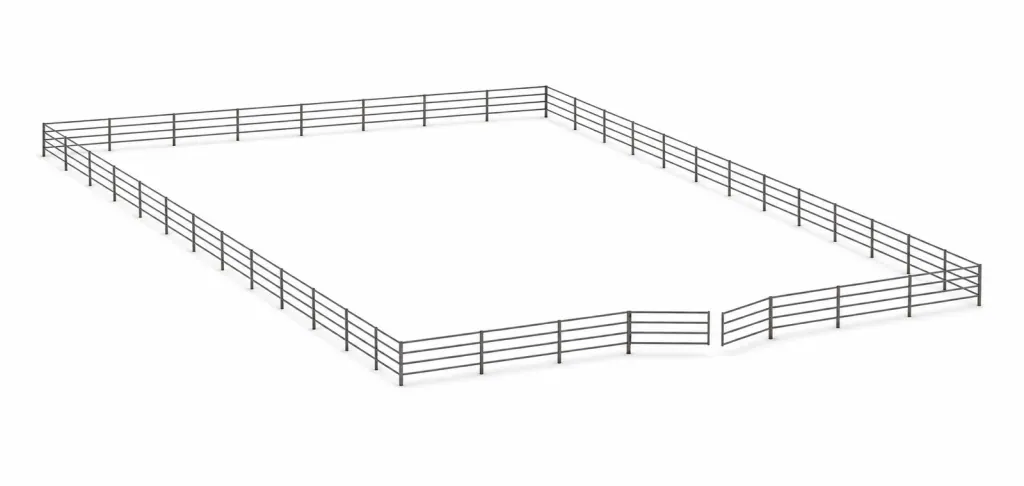
80×120 ft arena perimeter
A schooling arena for a horse or two on a small place in the Hill Country or outside Austin, San Antonio or Dallas–Fort Worth. At 9,600 sq ft it is the smallest pad to level, which counts on limestone you have to cut or Blackland clay you have to build up.
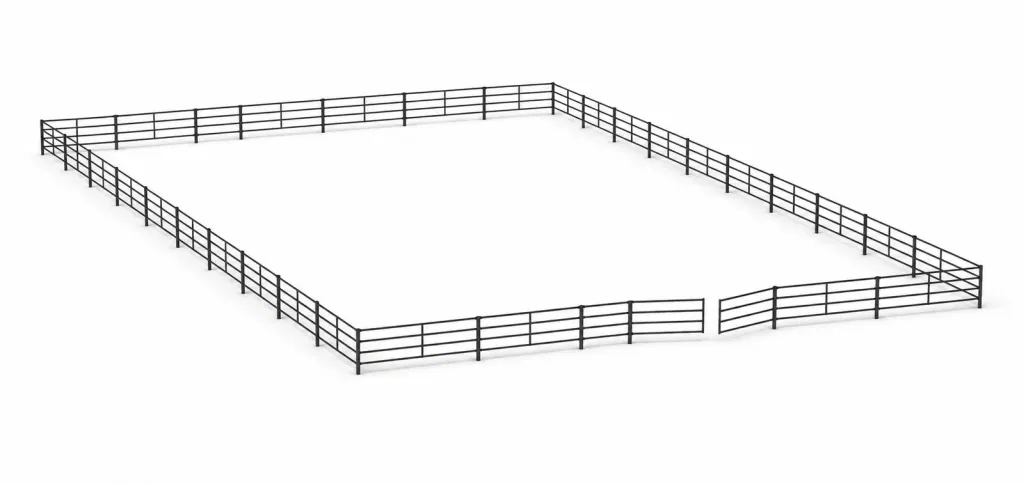
120×200 ft arena perimeter
Room for reining patterns, a slightly tightened barrel pattern or a 20 x 60 m dressage ring. A natural fit for the reining and cutting country around Fort Worth and Weatherford, or a lesson barn outside Houston, where riders want long sides without grading the largest pad.
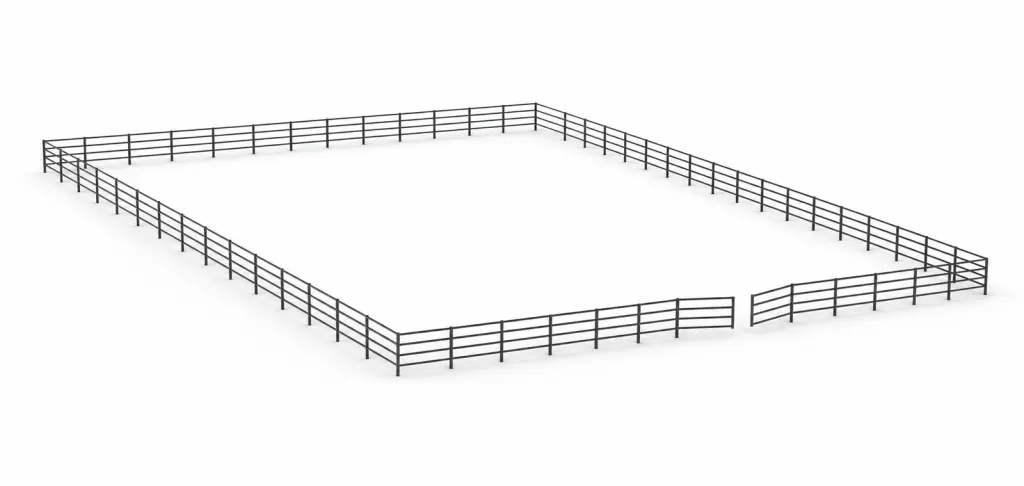
140×240 ft arena perimeter
The longest standard run, for team roping and full-size barrel patterns. It suits open, nearly flat ground on the High Plains, in South Texas or out west, where 33,600 sq ft of pad takes less cut and fill. Plan for 74 panels and plenty of water for the footing.
Caliche, Blackland clay or Gulf gumbo under a Texas arena
An arena pad is a big piece of ground. A 120 x 200 covers 24,000 sq ft, more than half an acre, so the soil under it matters more than it does under a round pen or a barn. On the High Plains around Amarillo and Lubbock, and across much of West Texas, caliche often lies close to the surface. Graded and compacted, it makes a hard, stable base, but water runs off it instead of soaking in, so a pad cut down to caliche needs a steady slope to one side.
Across the Blackland Prairie, from Dallas through Waco to Austin and San Antonio, the dark clay swells when it's wet and cracks wide in a drought, which can shift posts and leave footing uneven. In the Hill Country, limestone sits a few inches down, and leveling a slope means cutting rock or hauling fill. East Texas has sandy soil over red clay, and the Gulf Coast from Beaumont to Victoria is flat, heavy gumbo that stays wet for days. A dirt contractor who builds pads in your county can tell you what yours needs and how much fill a slope will take.
Texas heat, dust and sudden rain on arena footing
Rain runs from under 10 inches a year around El Paso to close to 60 near Beaumont, but nearly every part of Texas gets long summer stretches near or above 100 degrees. Sand footing dries fast in that heat and turns to dust, worst out west where the air is dry and the wind blows most afternoons. Watering is the usual answer, so put the arena within reach of a hydrant or a well line, or leave room to pull a water trailer around it. Watering 24,000 sq ft with a garden hose is slow work.
When rain comes, it often comes hard. A summer thunderstorm or a tropical system on the coast can drop several inches in a day, and an arena on low ground becomes a pond that takes days to dry. Grade the pad so water leaves it, keep runoff from the barn roof and the drive from running in, and give the water somewhere to go past the fence. On the High Plains, winter adds hard freezes, blowing dust and the odd snow. Frozen footing is hard on legs, so plan for fewer riding days from December to February.
Sizing a Texas arena for roping, barrels, reining or dressage
Start from the riding you do most. A standard barrel pattern puts the first two barrels about 90 ft apart and the third about 105 ft from each, with room to turn between every barrel and the fence. That fits the 140 x 240 at full size. In the 120 x 200 the pattern tightens a little, and the 80 x 120 suits slow work and drills. Team roping needs length more than width, because the steer needs room to run and the horses need room to stop. The 140 x 240 is the longest standard kit and handles practice at home; roping pens at rodeo grounds often run longer.
Reining and cutting run deep in North Texas around Fort Worth and Weatherford, and reiners want long sides for rundowns and stops, which the 120 x 200 gives them. A 20 x 60 m dressage ring, about 66 x 197 ft, just fits inside the 120 x 200 lengthwise, while the 80 x 120 is a little short for even the small 20 x 40 m ring. Leave about 20 ft outside the fence for a truck and trailer, a tractor and the mower. That turns a 120 x 200 into a level area close to 160 x 240 ft, nearly an acre.
Rails, a wider gate and a finish for a Texas arena
All three sizes use the same 10 ft panel, 5 ft tall, in 14-gauge steel: 1-5/8 in posts, 1-1/4 in rails run through the posts, a center support tube and welded end caps. Each size comes with four or five rails. Four rails leave gaps of about 14-1/4 in; five close them to about 10-1/4 in. Pick five for young horses, mares with foals or an arena where kids and visitors lean on the fence. Four is lighter and costs less, and it suits grown horses that respect a fence.
Every kit has two gates. A 10 ft panel gate combo with a 4-1/2 ft walk-through is for people leading horses, and a 10 ft swing gate that hangs on a 2-3/8 in hinge post and latches to a second 2-3/8 in post is for the tractor and drag. Measure your widest implement, wheels included; if it comes close to 10 ft, add a 12 ft arena swing gate. Bare metal costs least and weathers to a rust patina, faster on the humid coast than in the dry west. Dapple grey, black or a custom powder coat costs more and keeps its color.
Freight and unloading for a Texas arena kit
An arena kit is a big load: 38 panels for the 80 x 120, 63 for the 120 x 200 and 74 for the 140 x 240, plus the two gates and the clamps. Freight is priced from the road miles to your address, as one load, with a $200 minimum. You see the amount before you pay. Large orders ship free anywhere in Texas, and smaller orders delivered near I-10, I-40 or US-287 ship at a flat rate. Depending on its size, rail count and finish, an arena kit can reach the free-freight order size by itself. Contact us to confirm shipping for your order and delivery address.
The driver brings the load to your place but doesn't unload it. Have a tractor with forks or a skid steer ready; 70-odd panels by hand is a long day even with a crew. Pick an unloading spot on firm ground with room for the truck to turn around. After rain on Blackland or coastal clay, that means a gravel drive or the edge of the road, not the pasture. Steel travels loose, so scuffs and strap marks are normal. Count the panels and gates, photograph any damage and note it on the delivery receipt.
Ground posts, pad and footing for a Texas arena
An arena line needs ground posts, and they aren't in the kit. Set a post every two to three panels and clamp the panels to it, and don't set or concrete the panel legs themselves. On a 140 x 240 that works out to roughly 25 to 37 posts. Set the swing gate's hinge and latch posts first, plumb and in line, then run the panels out from them. In Hill Country limestone or Panhandle caliche a hand auger won't get far, so plan on a rock bit, a skid-steer auger or a fence contractor who has both.
Do the dirt work before the posts. Grade and slope the pad, compact the base, set the posts and hang the panels, then spread the footing last so it stays inside the fence. Footing is usually a few inches of washed sand or a sand blend; too deep is hard on tendons. Installation isn't part of the kit, so plan on your own crew or a local fence builder. Rural Texas counties have little zoning, but a city, deed restrictions or an HOA can limit fences and setbacks, so check before you build.