

Round pen kits for Oklahoma
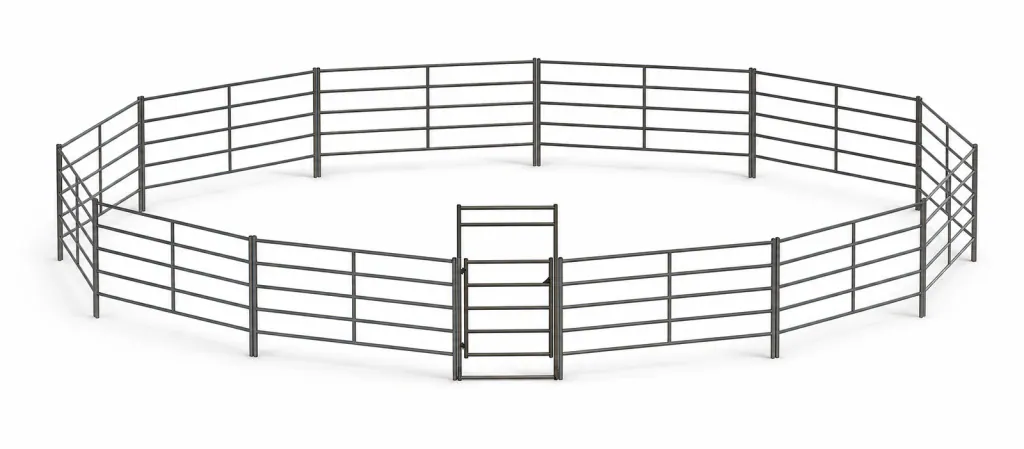
40 ft steel round pens
Groundwork on foot and starting young horses. It needs the smallest pad, which helps on a few acres outside Oklahoma City or Tulsa, or on sloping eastern ground where every extra foot of level circle means more digging.
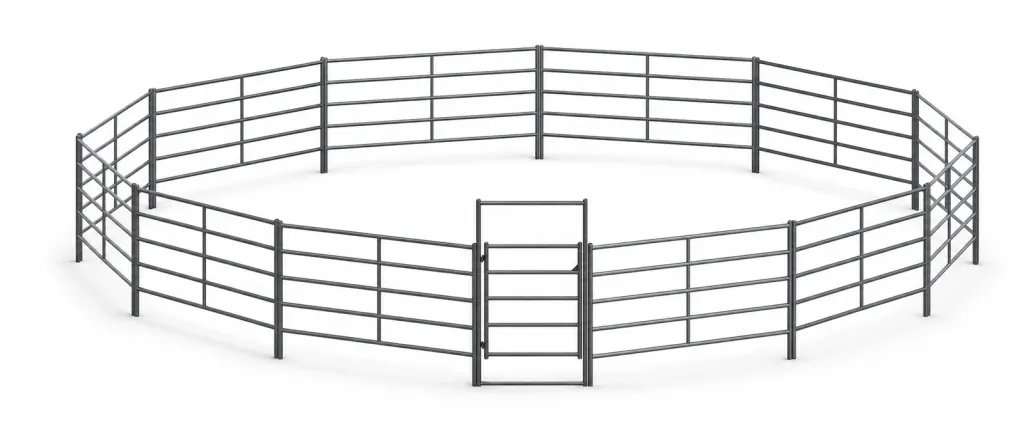
50 ft steel round pens
The usual pick for groundwork plus some riding, and the safe choice if you haven't decided. On central Oklahoma's red clay it keeps the pad you have to build up, crown and cover with footing to a manageable size.
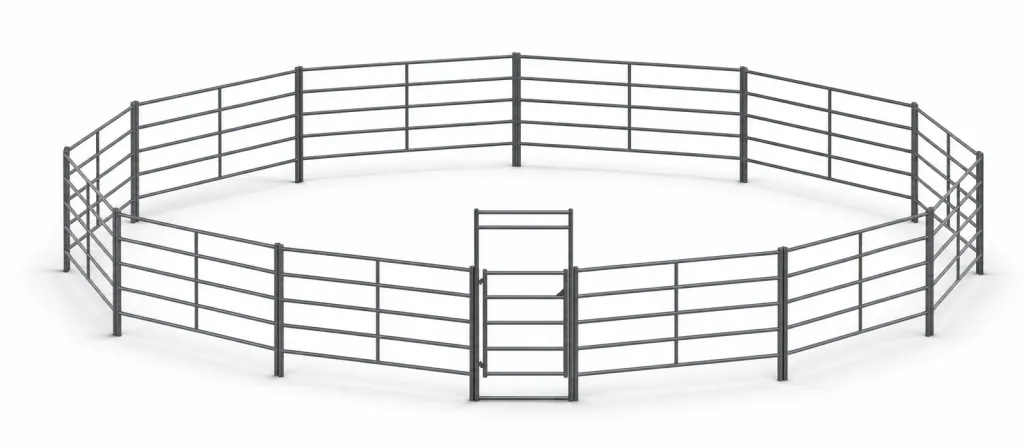
60 ft steel round pens
For riding in the pen regularly. The open, level ground of western Oklahoma and the Panhandle suits a 60 ft circle and the working room around it. Plan to keep the larger footing watered through the summer wind.
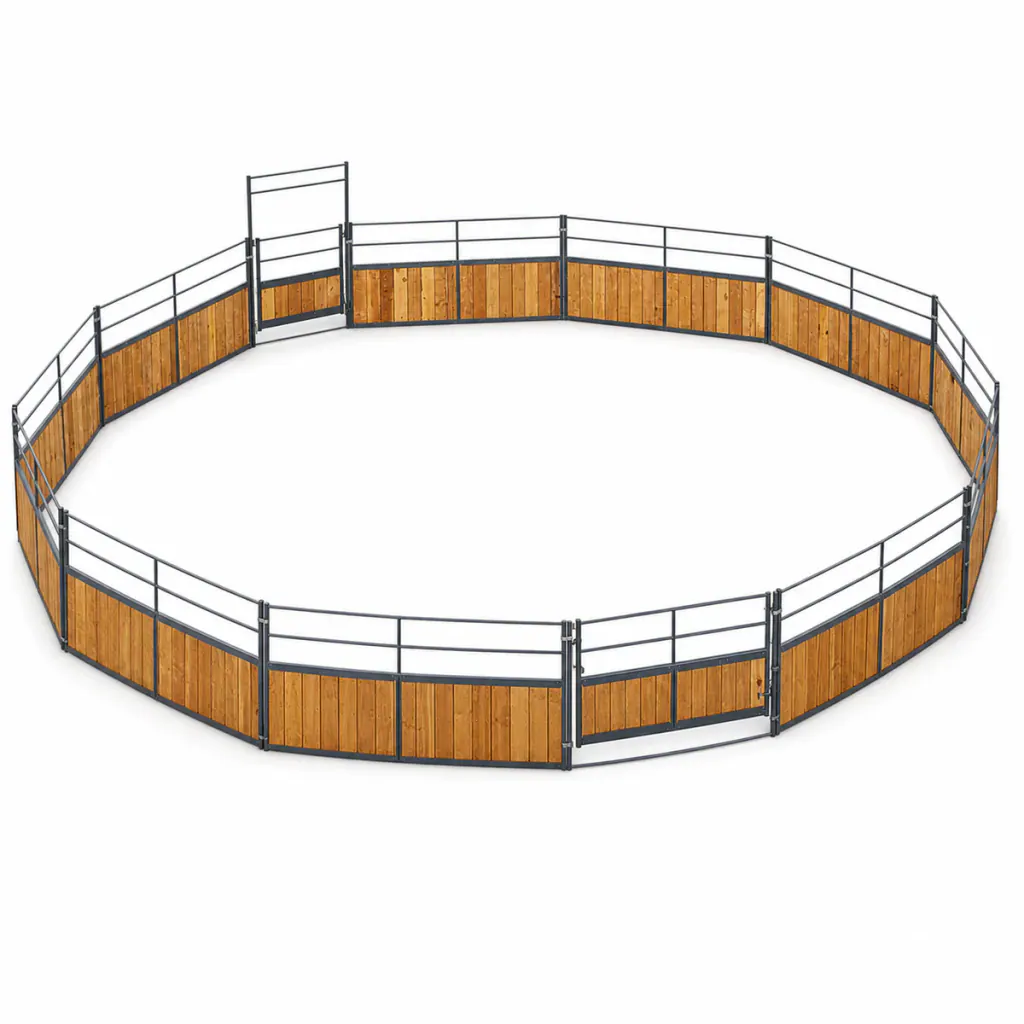
Wood-insert round pen
C-channel along the lower part of each panel holds 2x6, 2x8 or 2x10 boards you buy locally, and a separate 10 ft swing gate lets a tractor in to drag the footing. Solid boards block the view out, which helps keep a young horse's mind on you near a busy road. Wood is not included.
Red clay, sand or rock: start with the ground
Most of central Oklahoma sits on red clay. It packs hard in a dry August, turns slick and sticky after a spring rain and drains slowly, so water that runs into a round pen tends to stay there. Out west and along the Cimarron, Canadian and Red rivers the ground is sandier: it drains fast but shifts under hooves. In the northeast and southeast, the Ozark and Ouachita hills put chert and stone close to the surface, and a level spot can take some digging to find.
The panels stand on the ground and clamp together at the posts, so the pad decides how well the circle sits. On clay, build the pad a little higher than the ground around it and crown or slope it so rain runs out under the bottom rail instead of pooling in the middle. On sand, a firm, compacted base keeps the footing from turning deep. On rocky ground, clear stones from the whole circle before the panels go down, because rock keeps working up through footing. A dirt contractor who works in your county will know your soil better than any map.
Wet springs, dry summers and the Oklahoma wind
Rain in Oklahoma runs from less than 20 inches a year at the far end of the Panhandle to more than 50 in the southeast, and across most of the state May and June are the wettest months. That is also when most people want to start working horses. A pen built on low ground or across a draw can be out of use for days after a storm, so pick the highest workable spot near the barn and walk it after a heavy rain before you commit.
Summer brings the opposite problem. Heat and steady wind on the western plains dry sand footing out fast, and dry sand gets dusty and deep. If you plan to water the footing, put the pen within reach of a hydrant or a hose. Winter adds freeze-and-thaw cycles and the odd ice storm. Clay that heaves can tip a panel or drop one end of the gate, so walk the circle each spring, set anything that has moved back in line and tighten the clamps.
How much of your place a round pen takes up
The diameter is the circle itself. A 40 ft pen covers about 1,260 sq ft, a 50 ft pen about 1,960 and a 60 ft pen about 2,830, close to half again as much ground as the 50. Pad, base and footing are all bought by area, so the step from 50 to 60 ft adds about 870 sq ft of dirt work on top of the three extra panels. On a clay site that needs a built-up pad, that difference is worth pricing before you choose.
Leave working room outside the panels too. About 10 ft all the way around gives space to open the gate, lead a horse in, mow and drive a tractor around the outside, so a 60 ft pen wants a level area closer to 80 ft across. Put the gate on the side facing the barn or turnout so the walk in is short, and keep the circle back from a road or a neighbor's fence line, where traffic and loose dogs pull a young horse's attention away from you.
Four or five rails, and the bare steel finish
Every steel kit is 14-gauge steel with 1-5/8 in posts, 1-1/4 in rails and welded end caps, in 10 ft panels 5 ft tall. Four rails leave gaps of 14-1/4 in; five rails close them to 10-1/4 in. Pick five rails for young or green horses, ponies and minis, or for a pen the public can reach, like one beside a county road or at a boarding barn. Four rails is lighter, costs less and suits a settled horse.
Bare metal is the standard finish and costs the least. It weathers to a surface-rust patina, and it gets there sooner in the humid eastern half of the state than in the dry Panhandle. If you'd rather keep a color, dapple grey, black or a custom powder coat costs more and is picked on the product page. Powder coat changes the look and the price, not the panel underneath.
Delivery anywhere in Oklahoma
We ship round pens to every part of Oklahoma, from Guymon to Idabel. Freight is priced from the road miles to your address, as one load, with a $200 minimum. You see the amount before you pay. A pen and a few extra panels ship together for one charge. The free and flat-rate freight offers on our delivery page cover parts of Texas, New Mexico and Arizona, so Oklahoma orders are priced on distance.
The driver brings the load to your property but doesn't unload it. Plan for a tractor with forks, a skid steer or enough people, and an unloading spot the truck can reach on firm ground. After rain, a clay drive or a pasture gate can stop a loaded truck, so a gravel pad or the edge of a hard road is the safer place to meet it; carry the panels to the pad from there. Tell us about narrow gates, low wires or a steep drive when you order.
Setting the pen up yourself
A steel kit has no posts to set and no concrete. You stand the 10 ft panels in a circle, hang the 4.5 ft bow gate and fit the clamps: 26 for a 40 ft pen, 32 for a 50 and 38 for a 60. That matters on the rocky ground of eastern Oklahoma or the caliche in parts of the west, where an auger hits stone. One customer and their son put up a 60 ft pen in an afternoon. If you'd rather not, ask about installation with your quote.
Have the pad level and firm before the truck comes, set the panels on it, then bring in the footing so it stays inside the circle. Because nothing is buried, you can unclamp the pen and move it if a spot turns out to hold water, or take it with you if you sell the place. The Signature Series is the exception: its 10 ft swing gate hangs on an 8 ft by 2-3/8 in post that you set yourself, so check what's under that spot before you dig.