

Riding arena kits for New Mexico
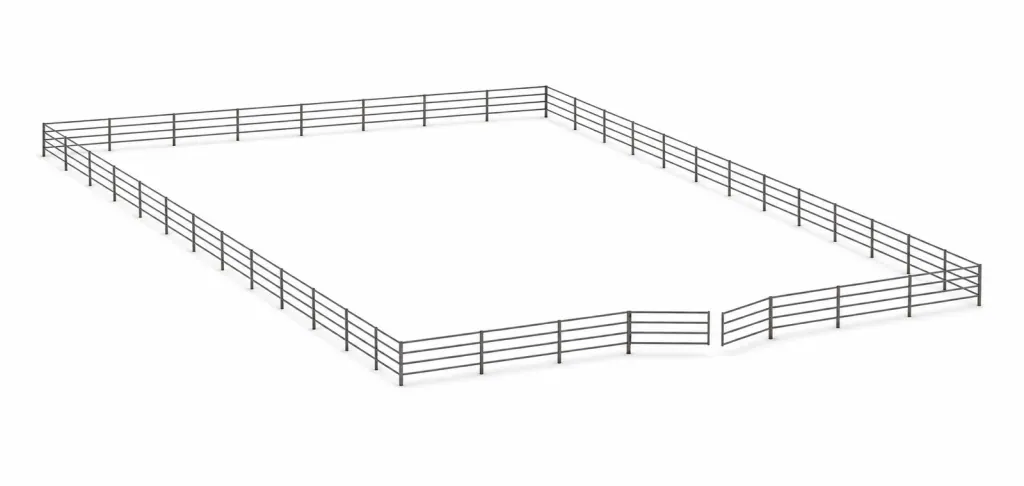
80×120 ft arena perimeter
A practical size for a few acres in the East Mountains, the Estancia Valley or Albuquerque's North Valley, where level ground is limited. A 9,600 sq ft pad is the least ground to grade, water and keep footing on through the spring wind, and it covers flatwork and groundwork.
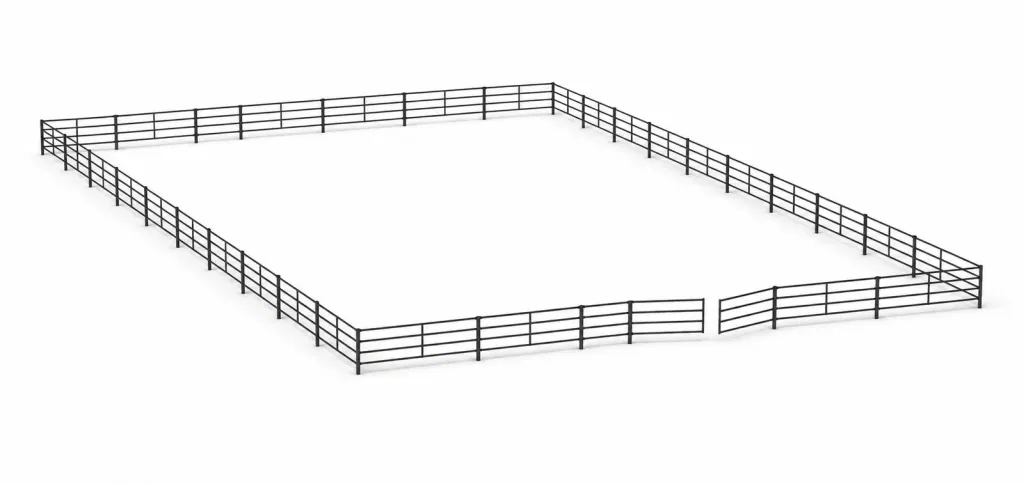
120×200 ft arena perimeter
Fits a 20 x 60 m dressage ring lengthwise and gives reiners long rundowns. It suits a small lesson or boarding barn in the Rio Grande valley between Los Lunas and Las Cruces, with the length riders want and less footing to water than the largest kit.
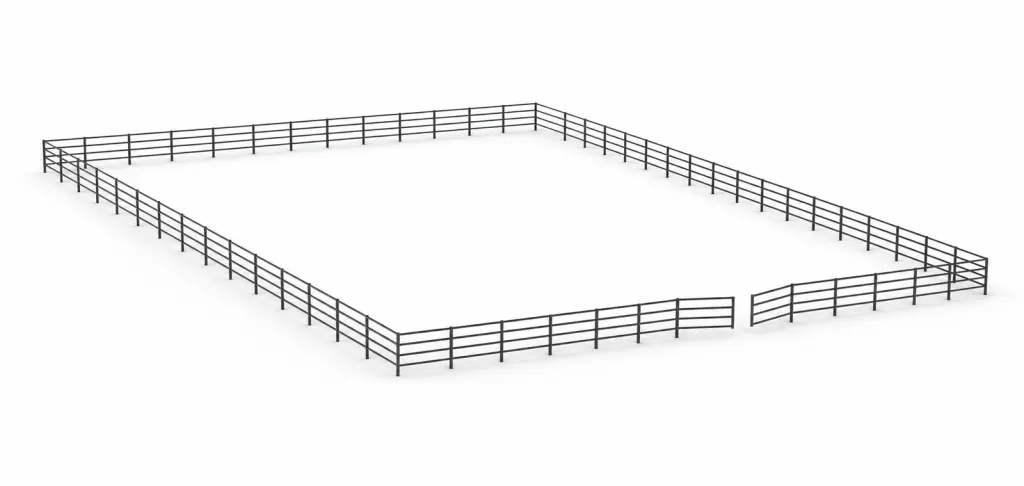
140×240 ft arena perimeter
For roping and full-size barrel patterns on the open eastern plains around Clovis, Portales and Tucumcari, where level ground is easier to find. Its 760 ft perimeter takes 74 panels. Site it clear of any draw that carries monsoon runoff, and close to a water line for the footing.
Caliche, gypsum and river-bottom soil under a New Mexico arena
Across southern and eastern New Mexico, a hard layer of caliche often sits anywhere from a few inches to a few feet down. On the Llano Estacado around Clovis and Portales, and on the mesas above Las Cruces and Albuquerque, a pad graded down to caliche is firm but sheds water instead of soaking it up. In the Rio Grande valley bottoms, from Española to the Mesilla Valley, soil can change from sand to heavy silty clay within a single field, and groundwater can sit close to the surface near the river.
Around Roswell, Artesia and the Tularosa Basin, gypsum soils soften when they get wet and can settle unevenly, so a contractor may want a thicker compacted base there. In the north, clay heaves when it freezes, and volcanic rock comes close to the surface around Taos and the Jemez. Before grading, talk to a contractor who builds pads nearby, or to neighbors who have built on the same ground. They can tell you how deep the caliche lies and whether your ground holds water or sheds it.
Spring wind, monsoon runoff and altitude at a New Mexico arena
Spring is the windy season. From March into May, afternoon gusts across the eastern plains and the Rio Grande valley lift dry sand footing and pile it in the corners or over the fence. The strongest spring winds come mostly from the west and southwest, so put the arena in the lee of a barn, a tree line or a rise if you can. Then plan for water. Much of the state gets less than 15 inches of rain a year, so work out how you'll damp 24,000 sq ft of footing, and check what your well and its permit allow.
Most of the year's rain falls from July into September, in monsoon thunderstorms that can drop an inch or more in a short burst. Dry arroyos run, and gentle slopes carry sheets of water. Keep the arena out of arroyos and off the foot of a slope, and give runoff a path around the fence. Elevation sets the season: Albuquerque sits near 5,000 ft and Santa Fe near 7,000, and higher sites see more frozen mornings. Down around Las Cruces and Deming, heat is the problem, and June rides start early.
Arena size for roping, reining and dressage in New Mexico
If you rope, length matters most. The 140 x 240 gives the longest run of the three kits and works for roping practice at home, although arenas at rodeo grounds are often bigger. It also holds a full-size barrel cloverleaf, with the first two barrels about 90 ft apart, the third about 105 ft from each and room left to turn at the fence. In the 120 x 200 the barrels have to come in a little. The 80 x 120 is a flatwork and groundwork arena, good for a horse or two and slow pattern practice.
Dressage riders get a full 20 x 60 m ring, about 66 x 197 ft, inside the 120 x 200, and reiners get long sides for rundowns and stops. Here, every square foot of arena is also a square foot to water and drag, so pick the 120 x 200 over the 140 x 240 unless you need the extra length for roping or barrels at speed. Leave 15 to 20 ft outside the fence for a truck, a trailer and the tractor. A 120 x 200 then needs a level area of roughly 160 x 240 ft.
Rails, gates and finish for a high-desert arena
Each kit uses 10 ft panels that stand 5 ft tall, built from 14-gauge steel with 1-5/8 in posts and 1-1/4 in rails. The rails run through the posts, a center tube stiffens each panel, and the end caps are welded shut. You choose four or five rails in every size. Five rails, with gaps of about 10-1/4 in, suit young horses, minis and arenas near a road. Four rails, about 14-1/4 in apart, cost less and suit settled horses that respect a fence.
Two gates come with every kit. Riders use the 10 ft panel gate combo, which has a 4-1/2 ft walk-through. Equipment uses the 10 ft swing gate, hung on a 2-3/8 in hinge post with welded hinges and latched to a matching post. If your drag or tractor is close to 10 ft wide, add a 12 ft arena swing gate. Bare metal is the standard finish, and in dry air it weathers slowly and evenly to a brown patina. Dapple grey, black or a custom color in powder coat, primer plus 2.5 mil of powder, costs more.
Arena freight to New Mexico along I-10, I-40 and beyond
An arena kit, its two gates, the clamps and any extra gate you add travel together. Freight is priced from the road miles to your address, as one load, with a $200 minimum. You see the amount before you pay. Large orders delivered near I-10 or I-40 ship free, and smaller orders near those two highways ship at a flat rate. That covers places on I-40 such as Gallup, Grants, Albuquerque and Tucumcari, and on I-10 such as Lordsburg, Deming and Las Cruces. Places well off both highways, such as Farmington, Taos or Roswell, are priced on distance. The delivery page has the order size and the exact areas.
The driver delivers to your property but doesn't unload, so have a tractor with forks, a skid steer or several strong helpers on hand. Rural New Mexico deliveries often end on a dirt road. Tell us about cattle guards, a sandy two-track, a steep grade or an arroyo crossing on the way in, because a loaded truck can bog down in soft sand or get stuck after a monsoon storm. Meet it on firm ground with room to turn, check the panel count and note any damage on the delivery receipt.
Setting arena posts in caliche and building the pad
Ground posts aren't part of the kit, and an arena needs them. Set one every two to three panels and clamp the panels to it; leave the panel legs standing on the pad, never set in concrete. That's roughly 13 to 19 posts around an 80 x 120 and 21 to 32 around a 120 x 200. Caliche stops a hand auger, so budget for a rock bit, a breaker bar or a contractor with a skid-steer auger. Set the swing gate's two posts first, plumb and square, then run the panels out from them.
Grade and compact the pad first, then set posts and panels, and spread the footing last so it stays inside the fence. Installation isn't part of the kit; plan on your own crew or a local fence builder. Check with your county before you build, and with the city or HOA if you're inside town limits or in a subdivision. In the north, if an acequia crosses the place, ask the ditch's commissioners or mayordomo where its right of way runs before you set a post near it.