

Riding arena kits for Arkansas
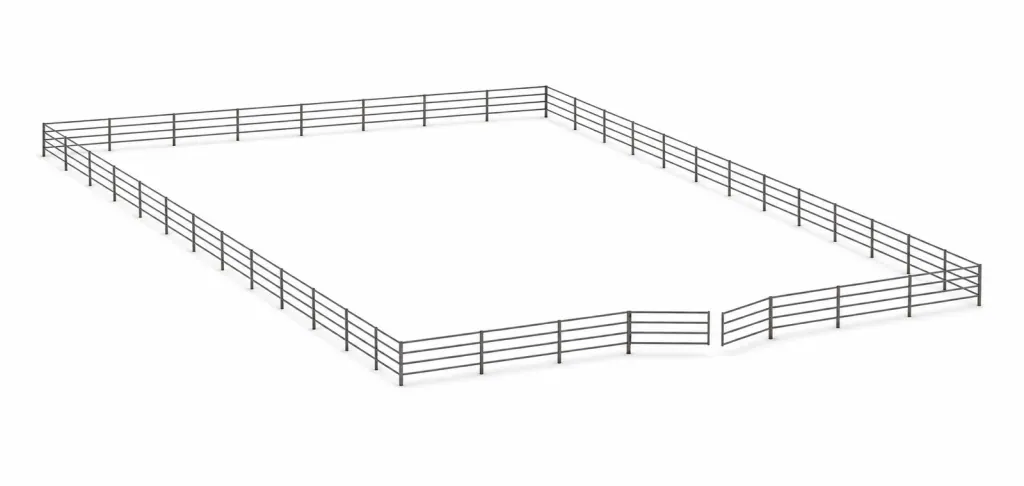
80×120 ft arena perimeter
Suits a hillside place around Harrison, Mountain Home or Hot Springs, where every foot of level ground is cut from a slope. The 80 x 120 is the smallest bench to grade and drain, with room for flatwork, groundwork and slow pattern practice on a horse or two.
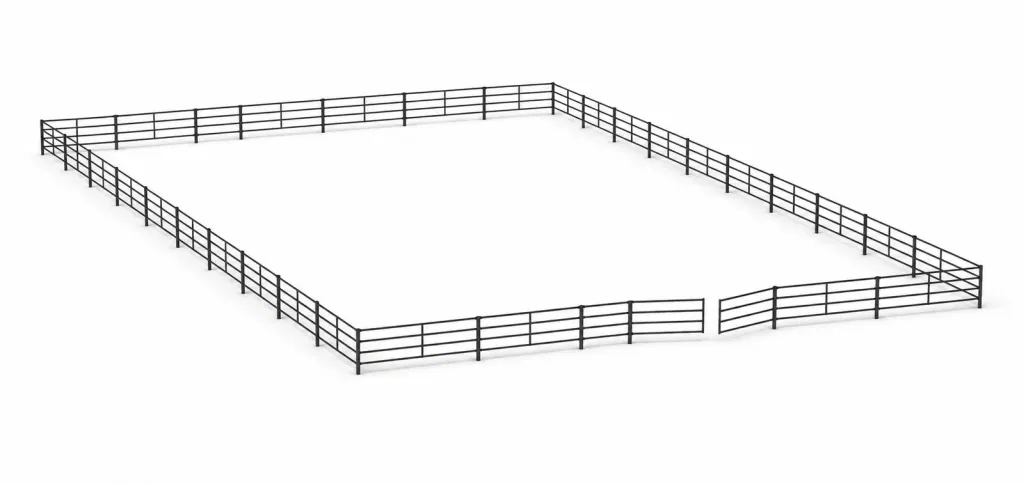
120×200 ft arena perimeter
Fits River Valley pasture between Fort Smith and Conway, or cleared timberland in south Arkansas. It holds a 20 x 60 m dressage ring or a slightly tightened barrel pattern, which is enough for lessons or a small boarding barn without the footing bill of the largest kit.
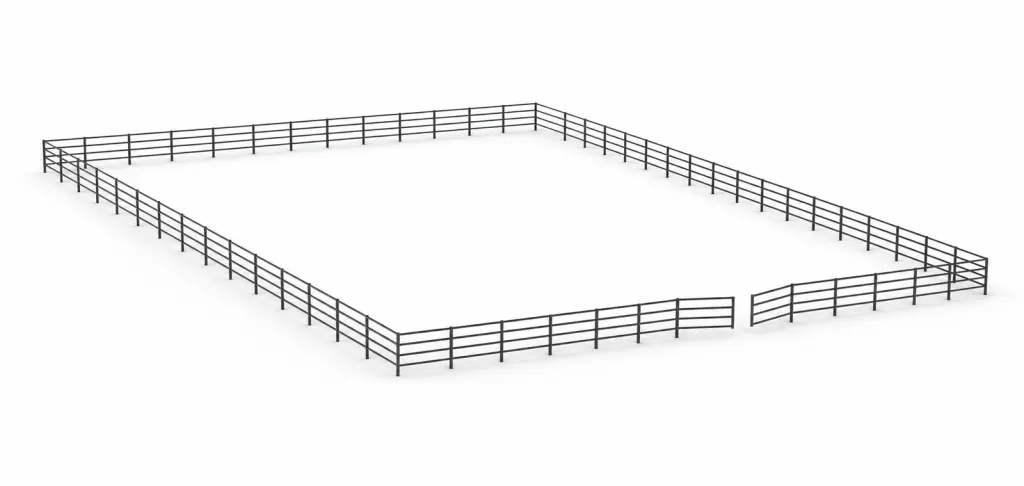
140×240 ft arena perimeter
For roping and full-size barrels on flat Delta farmland around Blytheville, Brinkley and Stuttgart. Flat isn't the same as dry on that heavy ground, so build the pad up above the field, slope it, and hang the swing gate on the high side where a truck can reach it.
Ozark chert, River Valley loam or Delta clay under an Arkansas arena
In the Ozarks, level ground is the scarce resource. A 5 percent slope looks gentle in a pasture, but it means a 6 ft difference across a 120 ft arena, so the pad is cut on the high side and filled on the low side. Fill has to be compacted in thin lifts, or it settles and the low corner of the arena sinks. Ozark soil is full of chert, and in the Boston Mountains and the Ouachitas around Mena, sandstone and shale often sit close to the surface.
The Arkansas River Valley from Fort Smith toward Little Rock has deep loam that works well, but the river and its creeks flood, so check the flood maps before you pick a spot. The Delta is flat, and much of it is heavy clay that farmers call buckshot: it breaks into hard chunks when dry and seals tight when wet, so water sits on top. South Arkansas timberland is mostly sandy loam over clay. Dig a test hole or two before you plan the base, so you know whether you're building on rock, loam or clay.
Rain, humidity and ice on Arkansas arena footing
Arkansas doesn't have a dry season to count on. Rain comes in every month, with spring often the wettest, and a 120 x 200 pad catches about 15,000 gallons for every inch that falls. On a cut-and-fill Ozark site, water also seeps out of the cut bank above the arena. A French drain or a ditch along the foot of that bank catches it before it reaches the footing. Slope the pad about 1 to 2 percent, and give the low side somewhere for water to leave instead of a fence line that dams it.
Humidity keeps footing damp for days after rain and slows drying in shade, so clear trees back from the south side if you can and let sun and wind reach the pad. Through July and August, heat and humidity push rides to early morning or evening. In winter, the Ozarks and the northern River Valley get ice storms that coat the panels and bring down limbs, and a falling branch can bend a rail. Keep big trees back from the fence line, and walk the arena after an ice storm before turning horses in.
Picking an Arkansas arena size for barrels, ranch riding or lessons
On a hillside, the size is often set by the bench you can grade, not by the riding you want. Measure the flattest ground first, add 15 to 20 ft around it for a truck and the tractor, and see which kit fits. With a 15 ft apron, the 80 x 120 needs about 110 x 150 ft of level ground. It suits flatwork, groundwork and slow pattern practice, and it is enough for one or two horses on a hobby farm. Even a small 20 x 40 m dressage ring, about 131 ft long, won't fit inside it.
For barrel racing at speed, the 140 x 240 holds a full-size cloverleaf, with about 90 ft between the first two barrels, about 105 ft to the third and room to turn at the fence. The 120 x 200 takes a slightly tighter pattern and a 20 x 60 m dressage ring lengthwise, with space for lessons with a few riders at once. Ranch riding patterns mix extended gaits, stops and lead changes along the rail and across the middle, which the 120 x 200 handles. On wet ground, bigger means more base and footing to keep drained.
Rails, gates and finish for humid Arkansas weather
Every arena kit is built from one panel: 10 ft long and 5 ft tall in 14-gauge steel, with 1-5/8 in posts, 1-1/4 in rails running through them, a support tube at the center and welded end caps. The real choice is the rail count. With four rails the gaps are about 14-1/4 in; with five they're about 10-1/4 in. Five rails suit foals, minis and arenas next to a road or a lane where dogs and four-wheelers pass. Four rails save weight and cost and work for grown horses used to steel panels.
Two gates come with each kit. The 10 ft panel gate combo has a 4-1/2 ft walk-through, so you can lead a horse in without swinging the big gate. The 10 ft swing gate hangs on a 2-3/8 in hinge post with welded hinges and latches to a second post with a chain keeper. On a Delta pad, put the swing gate where the approach stays firm after rain. Bare metal is standard, and Arkansas humidity turns it to a rust patina sooner than dry western air would. Dapple grey, black or a custom powder coat costs more and holds its color.
Arena freight to Arkansas hill roads and Delta farms
We ship arena kits anywhere in Arkansas, from Bentonville to Lake Village. Freight is priced from the road miles to your address, as one load, with a $200 minimum. You see the amount before you pay. Arkansas sits outside the areas our free and flat-rate offers cover, so the freight depends on distance. The 80 x 120 is 38 panels, the 120 x 200 is 63 and the 140 x 240 is 74, plus two gates and the clamps, and extra panels or gates on the same order ride along. Put everything on one order rather than adding pieces later, which would mean a second delivery.
The truck has to get in and turn around again, and the driver doesn't unload. Hill roads in the Ozarks and the Ouachitas can have hairpin turns, steep grades and low-water crossings that a loaded truck can't take after rain, and Delta field roads go soft fast. Tell us what the last few miles look like when you order. Have a tractor with forks, a skid steer or several helpers ready, unload on firm, level ground, and note any damage on the delivery receipt before the driver leaves.
Setting arena posts in Arkansas rock and clay
The kit doesn't include ground posts, but the fence needs them. Set one every two to three panels and clamp the panels to it, and leave the panel legs standing on the pad, out of the concrete. That's roughly 13 to 19 posts on an 80 x 120 and 25 to 37 on a 140 x 240. Chert and sandstone can stop a hand auger, so on Ozark and Ouachita ground use a skid-steer auger with a rock bit, or a fence crew that has one. In Delta clay, dig when the ground is dry enough to hold a clean hole.
Do the dirt work in order: cut and fill, compact and drain, then set the swing gate's posts and run the panels out from them. Spread the footing last so it stays inside the fence. A fill pad needs time and a few rains to settle before posts go in along its edges. Installation isn't part of the kit, so use your own crew or a local fence builder. Check with your county, and with the city or HOA if you're inside town limits or a subdivision, which matters in fast-growing Benton and Washington counties.