

Riding arena kits for Oklahoma
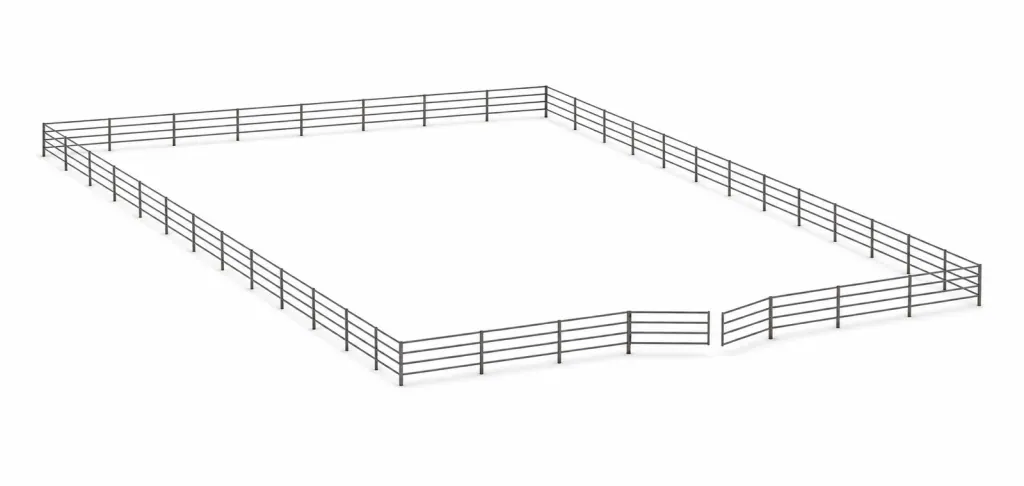
80×120 ft arena perimeter
Fits a few acres around Edmond, Norman or Broken Arrow, where a house, a barn and pasture share the land. Its 400 ft of fence and 9,600 sq ft pad suit flatwork, groundwork and a horse or two, and it means the least red clay to raise, slope and cover with footing.
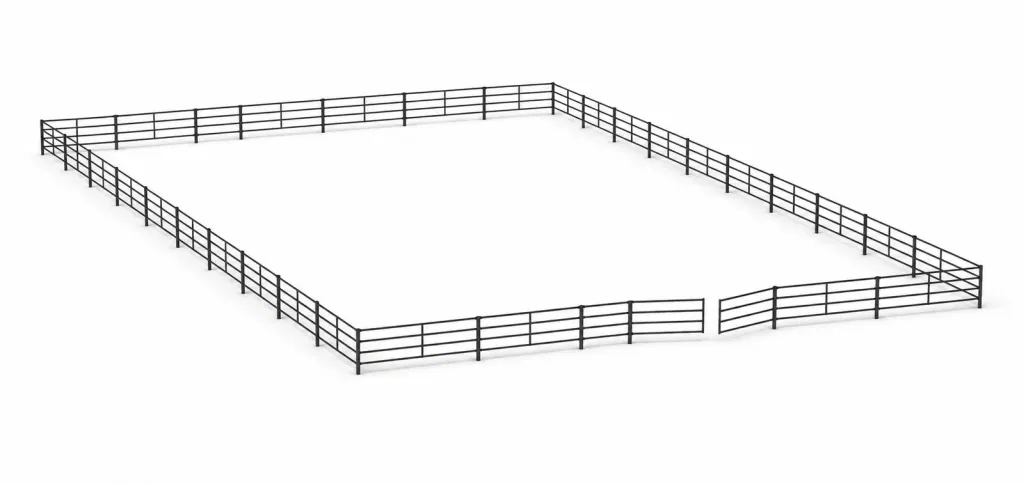
120×200 ft arena perimeter
A strong fit for reining and ranch riding on the small horse places between Guthrie, Stillwater and Purcell. Its long sides give room for rundowns and stops, and it holds a 20 x 60 m dressage ring, without the dirt work and footing bill of the largest kit.
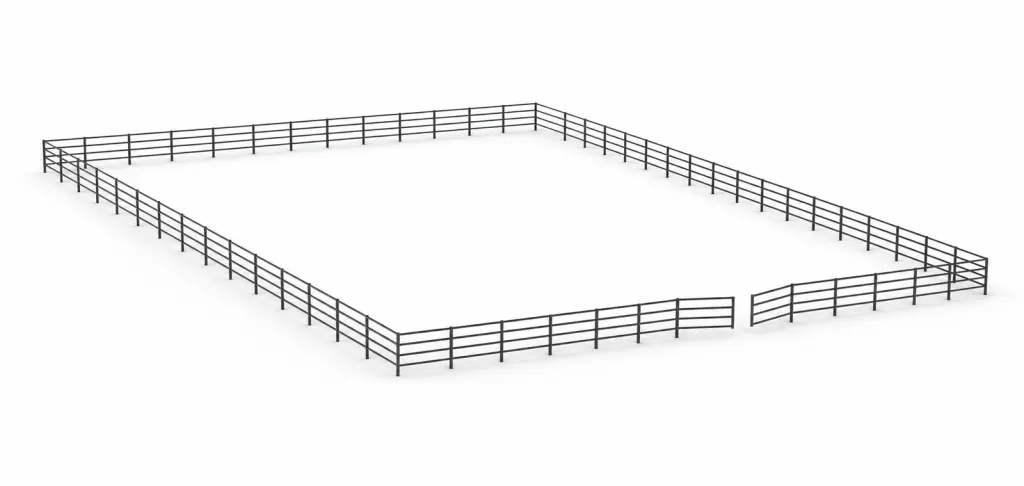
140×240 ft arena perimeter
For roping and full-size barrel patterns on the open wheat ground around Enid, Clinton and Altus, where a level acre is easier to find. It takes 74 panels and a lot of footing, so put it near a water line that can keep the footing damp through the summer wind.
Grading an Oklahoma arena on red clay, gyp or chert
Most arena pads in central Oklahoma start on red clay. Clay takes in water slowly, so the pad itself has to move rain off. A slope of 1 to 2 percent is the usual target, and even 1 percent works out to about 14 in of fall across a 120 ft width. Slope the pad to one side, or crown it gently along the long axis, and compact the base in lifts. A base that settles unevenly leaves low spots where water stands for days after a storm.
In the northwest, the Gyp Hills around Alva, Freedom and Woodward put gypsum and soft red shale near the surface. Gypsum can dissolve and settle where water collects, so keep runoff moving off the pad and away from it. Along the Cimarron and Canadian rivers, sandy bottomland drains well but needs a compacted base to stay firm. Green Country's Ozark soils are full of broken chert, and in the Ouachitas and the Arbuckles, solid rock can stop a cut short. Dig a few test holes across the pad before you hire the dirt work, so you know what sits a foot down at each end.
Storm season, summer wind and ice on an Oklahoma arena
May and June bring the heaviest rain to most of the state, often in evening thunderstorms that drop an inch or two at once. On a 140 x 240 pad, every inch of rain is roughly 21,000 gallons of water that has to go somewhere. Before you grade, look at what drains toward the site: a pasture slope above it, the barn roof or a gravel drive. A shallow swale or a low berm on the uphill side turns that water around the fence, so the pad handles only the rain that falls on it.
By July and August the problem is drought. Hot south winds dry sand footing in an afternoon, and loose, dry footing gets dusty and deep, so plan a water source a hose, a sprinkler line or a water trailer can reach. Winters are short but can be rough. Ice storms coat the panels, and freezing and thawing clay can push ground posts up out of their holes over a few seasons. Drag the footing smooth before a hard freeze so it doesn't set up in ruts, and check the posts for lift every spring.
Matching the arena to reining, roping or barrels in Oklahoma
A lot of horses in central Oklahoma are trained for reining or ranch riding. Reiners need long, straight sides for rundowns and room at each end to stop and turn around, and the 120 x 200 gives them that. A 20 x 60 m dressage ring, about 66 by 197 ft, also fits inside it lengthwise. The 80 x 120 covers flatwork, groundwork and slow pattern work for one or two horses, and it is the least dirt work on clay that has to be built up.
Barrel racers and ropers usually want the 140 x 240. A standard cloverleaf puts the first two barrels about 90 ft apart and the third about 105 ft from each. That pattern fits at full size with turning room to the fence, while in the 120 x 200 it has to come in a little. Roping pens at rodeo grounds often run longer still. Leave an apron of about 15 to 20 ft on every side for trucks, trailers and the tractor, and a 140 x 240 then needs 1 to 1.2 acres of level ground.
Rail count, extra gates and finish for an Oklahoma arena
The panels are the same in all three sizes: 10 ft long and 5 ft high, in 14-gauge steel with 1-5/8 in posts and 1-1/4 in rails that run through the posts. A center support tube braces each panel, and the end caps are welded on. Four rails leave about 14-1/4 in between them, and five rails narrow that to about 10-1/4 in. Five rails make sense for weanlings, ponies and an arena that hosts practice nights with people along the rail. Four rails are lighter, cost less and are plenty for broke horses.
Each kit includes a 10 ft panel gate combo with a 4-1/2 ft walk-through for riders, and a 10 ft swing gate on 2-3/8 in hinge and latch posts for the tractor. If you bring cattle in for roping practice, or want a second way in from a turnout, add another 10 ft swing gate or a 12 ft one; the extra arena gates stand 4 ft tall. Bare metal is the standard finish and weathers to a rust patina, sooner in Green Country's humidity than on the High Plains. Powder coat in dapple grey, black or a custom color costs more.
Freight for an arena-sized order to Oklahoma
Arena kits ship to every corner of Oklahoma, from Boise City in the Panhandle to Broken Bow in the southeast. Freight is priced from the road miles to your address, as one load, with a $200 minimum. You see the amount before you pay. Our free and flat-rate offers don't reach Oklahoma addresses, so an Oklahoma order is priced on distance. Depending on size, the kit is 38, 63 or 74 panels plus two gates and the clamps, and any extra gates or panels you add on the same order ship with it. Ordering everything at once avoids a second freight charge later.
The driver doesn't unload. Line up a tractor with forks, a skid steer or a crew, because carrying 63 or 74 panels off a truck by hand takes most of a day. Pick the spot where the truck will stop with the weather in mind: wet red clay can bog a loaded semi, so after a storm, plan to meet it on gravel or hard ground near the road and move the panels from there. Mention narrow cattle guards or low lines when you order, count the panels and gates when they arrive and write any damage on the receipt.
Post holes, footing and county rules for an Oklahoma arena
Ground posts don't come with the kit, and every arena needs them. Put one every two to three panels and clamp the panels to it, and leave the panel legs standing free rather than setting them in concrete. A 120 x 200 takes roughly 21 to 32 posts. Red clay digs well when it's dry and turns to glue when it's wet, so plan the post holes for a dry week. In chert, Ouachita sandstone or Arbuckle limestone, rent a rock auger or hire a fence crew that has one. Set the two swing-gate posts first and run the panels out from there.
Grade and compact the pad, set the posts and panels, then haul in the footing last so it stays inside the fence. Reining horses slide best on a firm base with a thin layer of loose footing on top, while barrel and roping horses usually get a little more depth; too deep is hard on tendons. Installation isn't part of the kit, so the work falls to your own crew or a local fence builder. Check with your county first, and with the city or HOA if you're inside town limits or a subdivision, since they can set fence heights and setbacks.